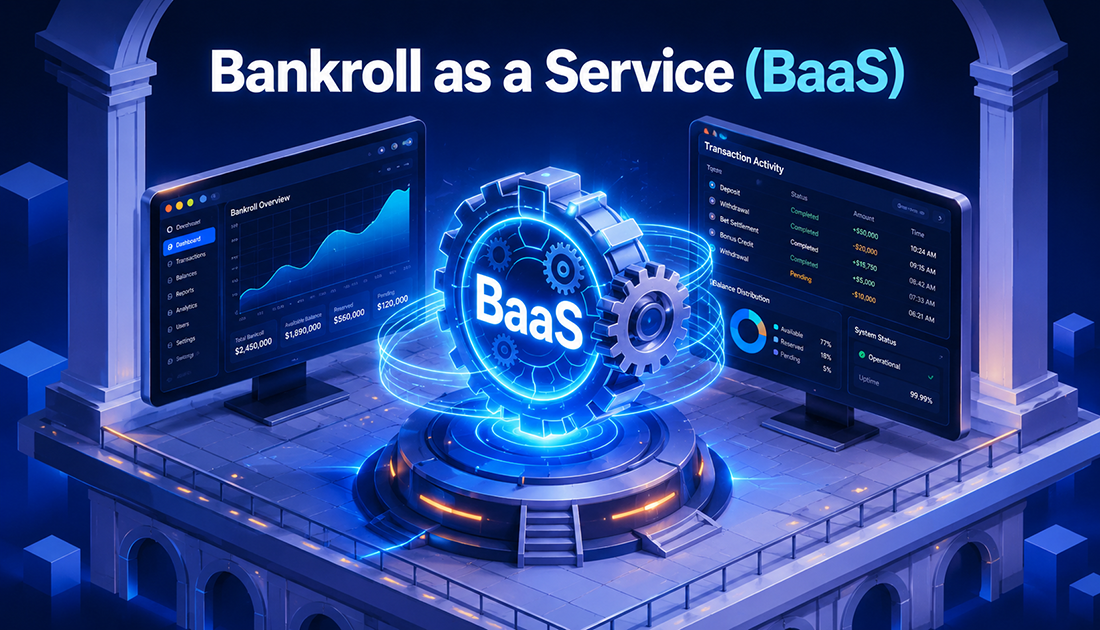
The term BaaS — Bankroll as a Service — has started appearing in iGaming conversations, particularly around crypto-native operators and growth markets. The problem is that it is being used to mean several different things at once, and most operators evaluating it for the first time end up confused about what they are actually buying.
This is the definitional version. What BaaS is. What it isn't. Why it matters now. And what to look for in a provider.
The simple version
Bankroll as a Service is the externalisation of an iGaming operator's bankroll, liquidity, and risk management — the financial engine that sits underneath the bets and the games — to a specialised third party that provides it as managed infrastructure.
In the conventional iGaming model, every operator has to hold their own bankroll. They have to capitalise it. They have to manage liquidity to cover withdrawals on demand. They have to absorb the variance of large wins against their player base. They have to hedge risk on sportsbook positions where exposure goes long. They have to model expected value across the games on their casino. And they have to do all of this with their own balance sheet on the line.
For a large operator with mature treasury operations, this is manageable. For a new operator, a fast-launch operator, an operator in a growth market, or a crypto-native operator launching without large pre-funded reserves, it is the single biggest barrier to going live. The bankroll requirement isn't a feature you can add later. It is the thing that determines whether you can take a bet at all.
BaaS removes that barrier. A specialist provider holds the bankroll, manages the liquidity, absorbs the variance, hedges the risk, and provides the financial engine to the operator as a service — usually for a share of GGR. The operator gets to run a competitive sportsbook and casino without putting up the capital, and without having to build the treasury and risk function from scratch.
What BaaS is not
There are three things BaaS is regularly confused with.
It is not Backend as a Service. The acronym collides with the cloud-computing concept of Backend-as-a-Service — Firebase, Supabase, that family of products — and the two are sometimes treated as related. They are not. iGaming BaaS is a financial infrastructure category. The cloud BaaS is a development infrastructure category. The only thing they share is the acronym.
It is not a payment processing service. Payment processors move money between the operator, the player, and the banking system. They handle deposits, withdrawals, settlements, and reconciliation. A payment processor does not hold the bankroll, does not absorb variance, and does not take on risk exposure on the operator's positions. BaaS sits upstream of the payment layer.
It is not a white-label casino. White-label providers give operators a complete branded product to run, including the games, the platform, and often the licence. In a white-label model, the underlying platform provider holds many of the financial relationships and the operator effectively gets a revenue share of the player base they bring in. BaaS is more modular: the operator retains their own brand, their own player relationship, their own platform decisions, and procures only the bankroll and risk layer from the BaaS provider.
BaaS is the financial engine of an iGaming operation, provided as managed infrastructure — separate from the platform, separate from payments, separate from the white-label model.
Why BaaS is becoming a category now
Three trends have converged.
The first is the rise of fast-launch operators in growth markets. Africa, Brazil, parts of Asia, and the crypto-native segment are seeing a wave of new operators who want to enter the market in months rather than years. They have brand ideas, market access, and acquisition capacity, but they don't have — and often can't raise — the capital reserves that a traditional operator would put up. Externalising the bankroll is the only way these operators can credibly launch.
The second is the maturation of crypto and Web3 iGaming infrastructure. On-chain transparency, programmable wallets, and tokenised liquidity have made it possible to structure bankroll arrangements that would have been operationally difficult a few years ago — including bankrolls held in stablecoins, transparent proof of reserves, and investor-backed liquidity pools where third parties take risk exposure on the operator's behalf in exchange for yield. The technical primitives for BaaS have arrived alongside the operator demand.
The third is specialisation. The iGaming industry is unbundling — what used to be one monolithic platform decision is now a stack of separately procured services. Operators pick their game providers, their payment rails, their KYC vendors, their CRM, their CS tools, their compliance tools, their affiliate trackers. The platform itself has been the slowest layer to unbundle, but it is now happening, and BaaS is part of how. An operator can procure their platform from one provider, their bankroll from another, their game content from a third, and their CS infrastructure from a fourth, without losing operational coherence.
What an operator actually gets from BaaS
In practice, an operator buying BaaS gets the following stack of capabilities from a single provider.
Capitalised liquidity — the bankroll itself, sized to the operator's expected betting volume, available to cover withdrawals on demand and absorb player wins as they happen. The operator does not have to hold this capital on their own balance sheet.
Risk modelling and pricing — the BaaS provider's risk engine models the expected value across the operator's product set, prices the variance, and sets the parameters within which the operator can offer markets and games. Sportsbook hedging, casino RTP management, jackpot pool handling, and exposure limits are all handled at the BaaS layer.
Variance absorption — when an operator has a bad month, a big winner on a high-RTP slot, or a sportsbook book that goes long against them, the BaaS provider absorbs the variance. The operator's GGR fluctuates, but their solvency does not. This is the load-bearing benefit of the model: it converts the operator's financial profile from "capital-intensive with downside risk" to "asset-light with predictable margins."
Compliance and audit infrastructure — bankroll management touches AML, responsible gambling, and player fund segregation regulations in most jurisdictions. A specialist BaaS provider builds this once and amortises it across their operator base, which is dramatically more efficient than every operator building it independently.
Reporting and reconciliation — the operator gets a clean view of their bankroll position, their margin, their exposure, and their reconciled financial state, without having to staff a treasury function. The BaaS provider's tooling does it.
The commercial model is typically a share of GGR — somewhere in the 15–25% range, varying with the operator's risk profile and the level of capital backing the BaaS provider has to deploy. For a new operator, this is often dramatically better than the all-in cost of holding their own bankroll, building their own risk function, and absorbing variance with their own equity.
What to look for in a BaaS provider
The category is young, and the providers calling themselves BaaS today vary widely in what they actually deliver. There are a few things to look for.
Real capital backing. Some providers describe themselves as offering BaaS but are effectively just risk advisory services with thin balance sheets. If the bankroll isn't genuinely capitalised, the variance absorption isn't real — and the moment the operator has a bad month, the model breaks. Ask about the capital base, the investors behind it, and the operator volume it is sized to support.
Genuine risk management. Holding a bankroll is one thing. Pricing the risk on the operator's product set, hedging sportsbook positions, modelling jackpot exposure, and adjusting RTP parameters dynamically is a different and much harder thing. The providers who do this well have built or acquired specialist risk teams. The providers who haven't are running a much riskier book than they realise.
Integration with the operator's platform. BaaS is only useful if it is wired into the operator's wallet, payment, and game systems with the right authentication, audit trails, and rollback behaviour. A BaaS layer that requires the operator to do significant integration engineering to connect it is a partial product. Look for providers whose BaaS integrates cleanly with the platform layer beneath it.
Regulatory positioning. Bankroll management has regulatory implications — player fund segregation rules, AML, responsible gambling. A BaaS provider operating in jurisdictions where this is uncertain is taking on risk that ultimately lands on the operator. Look for providers with clear regulatory positioning in the markets the operator is serving.
Crypto-native capability where relevant. For operators in the crypto and Web3 segment, the BaaS provider needs to handle stablecoin bankrolls, on-chain transparency where the operator wants it, and the operational realities of crypto deposits and withdrawals. Not all BaaS providers can do this. The ones that came from a Web3 background can. The ones that retrofitted from fiat-only operations often cannot, or do it badly.
BaaS at Bluestuff
Bluestuff offers BaaS as a standalone service, separately from the agentic platform. An operator can procure the full Bluestuff platform — with the workforce of specialised AI agents that build, run, and grow the operation — or they can procure only the BaaS layer and run it under their existing platform stack.
The architecture matters. Bluestuff's BaaS is built on the same enterprise-grade infrastructure that supports the wider platform, with the same compliance controls, audit logging, and integration patterns. The risk engine is genuinely capitalised, with backing structured for growth-market deployment. And the BaaS layer is Web3-native by design — built-in stablecoin support, transparent reserve reporting where the operator wants it, and crypto-wallet compliance from day one, not retrofitted from a fiat-only original.
For an operator considering BaaS, the strategic question is not just "can I externalise my bankroll" — the answer is increasingly yes — but "who do I want my bankroll partner to be." The right answer is a provider whose financial engineering is real, whose risk management is sophisticated, whose platform integration is clean, and whose architecture matches the markets the operator is actually operating in. The wrong answer is a provider whose BaaS offering is a marketing label on top of a capital-thin advisory service.
The category will mature fast
BaaS is at the same stage of category development that Backend-as-a-Service was in cloud computing around 2014 — the term is in use, the model is real, but the providers calling themselves BaaS today vary enormously in what they actually do. Over the next two or three years, the category will consolidate: the providers with real capital and real risk infrastructure will absorb operator volume from the lighter offerings, and the term will tighten around a clearer definition.
For operators evaluating BaaS now, the practical guidance is to look past the label and evaluate the substance. Capital backing, risk modelling, platform integration, regulatory positioning, and crypto capability are the questions that matter. The providers that answer them well will be the ones that define the category.
Bluestuff.ai provides Bankroll as a Service as part of the agentic operating system for iGaming, or as a standalone service for operators running on other platform stacks.