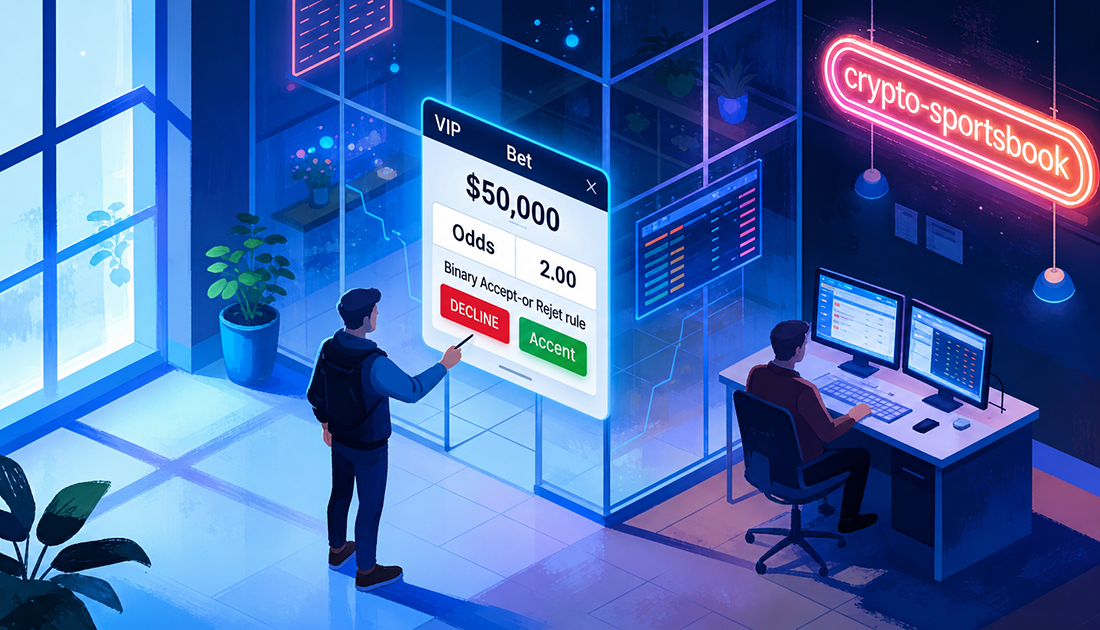
A VIP places a bet. The illustrative number is large — say $50,000 at odds of 2.00 — and it is the kind of bet that defines a relationship with a player. On most platforms, what happens next is decided in a fraction of a second by a rule. The bet either fits inside a pre-set liability limit and goes through, or it breaches the limit and gets rejected. There is no third option, because there is no one in the loop to provide one. The player who wanted to put fifty thousand on a match gets a flat decline, and the operator who wanted that player’s action loses it.
This is the moment that exposes the gap between a platform that hosts a sportsbook and a platform that can actually run one. We built a real-time bet-referral desk for a crypto sportsbook — a trader-in-the-loop capability that turns the binary accept-or-reject into a human judgement call made in seconds — and it is worth explaining why, because it is the kind of thing no white-label platform offers and most cannot.
The problem: an over-limit VIP bet
Every sportsbook runs on liability limits. There are limits at the user level — how much exposure the book is willing to carry against a single player — and limits at the brand level, across the whole operation. These limits exist for good reasons. They are the difference between a bad night and an insolvent one. The Risk Engine enforces them automatically, and for the overwhelming majority of bets that is exactly the right behaviour: the bet sits inside the limits, it is accepted instantly, and nobody thinks about it.
The hard case is the bet that breaches a limit. A VIP who wants to stake more than the user-level limit allows, on a market where the brand-level exposure is already running long, is simultaneously the most valuable player on the book and the one the automated rule is built to turn away. A flat reject protects the liability. It also tells your best player that the answer is no — and a player who hears no enough times takes their action somewhere that says yes. The instinct to simply raise the limit is worse, not better, because it solves nothing and removes the protection entirely.
What the big books do about it
The largest sportsbooks in the world have always solved this with people. When a high-roller’s bet breaches a limit, it does not get auto-rejected — it lands in front of a trader. A human who can see the player, the market, the current exposure, and the shape of the book makes a call: take it at the original odds, take part of it, offer a different price, or decline. That decision happens in seconds, and it is the difference between keeping a five-figure bet and waving it away.
This is not a back-office nicety. It is one of the most commercially significant capabilities a serious book has, and it is precisely the capability that does not survive the transition to off-the-shelf software. The judgement is real, the timing is tight, and the upside is concentrated in exactly the players an operator least wants to lose.
That few-seconds-of-human-judgement is where an enormous amount of VIP revenue lives.
Why white-labels can't take this bet
The white-label model is built to standardise. One platform serves many operators, so the logic that governs a bet has to be the logic that works for everyone — and a referral desk is the opposite of standard. It needs a back-office surface wired into the live Risk Engine, a configurable decision window, an operator-override path back into the Sportsbook backend, and a player-facing state that holds calm while a human thinks. None of that is a setting you toggle on a shared platform. It is a build, and it is a build the white-label vendor has no reason to do for a single operator’s VIP desk.
So the white-label sportsbook limitations show up exactly where the money is. The bet that breaches a limit hits a rule, the rule returns a reject, and the conversation ends. There is nowhere for a trader to stand in that flow, because the flow was never designed to have one. This is the difference between configuring a product and building one — and it is the difference an agentic build is for. Bluestuff.ai, the agentic operating system for iGaming, does not hand an operator a menu of toggles; it builds the capability the operator actually needs into their own custom crypto sportsbook.
One rule, one outcome. The bet that matters most is the one the rule is built to turn away.
A trader-in-the-loop step the flow was actually designed to have — keep the action, control the liability.
How the bet-referral desk actually works
Start with the bet. A player places it, and the frontend immediately shows a waiting state with a timer. The Sportsbook backend sends the bet to the Risk Engine, which checks it against the user-level and brand-level liability limits. Most bets clear here and are accepted on the spot — that is the path the vast majority of stakes take. The interesting flow begins only when the Risk Engine rejects the bet for breaching a limit.
At that point the system splits, and which way it splits depends on the account.
For a standard account, the system returns an instant automated counter-offer: a reduced maximum stake, alternative odds, or both. The player accepts or declines. On accept, the bet is re-placed with an operator-override and confirmed. No human is involved, and the whole exchange happens in the time it takes to read a single line on screen.
For a VIP account, the bet is routed into a real-time bet acceptance queue and surfaced on the Trading Desk in the back office. A human trader now has the decision — and a window of seconds, configurable and extendable, to make it. If the trader acts, the bet is settled on their call. If nobody acts before the window closes, a graceful auto-fallback fires, dropping the player back onto the same automated counter-offer a standard account would have received. The book is never left exposed by an empty chair, and the player is never left staring at a dead screen.
What the trader sees
When a VIP bet lands on the Trading Desk, the trader does not see a stripped-down alert. They see the full picture, assembled in real time. The original stake and the original odds requested. The current odds in the market. Any alternative odds the system can offer. The maximum stake the limits would allow. And around all of that, the context that makes the decision possible: the player’s risk profile, the current liability, and the market and team exposure the book is already carrying.
This is VIP bet liability management as an operational surface rather than a spreadsheet. The trader is not guessing whether this bet is safe; the screen tells them precisely where it sits against the book. They can take a large bet they understand and decline a small one they do not, because the information to tell the difference is in front of them, in the few seconds they have to act.
The decision options
The trader’s call is not a yes-or-no toggle. There are four moves, each with a clear consequence, and the right one depends on what the screen is showing.
- Accept — take the bet at the original stake and original odds. The player gets exactly what they asked for.
- Accept with current or alternative odds — take the bet, but at a price that reflects where the market has moved or where the book wants the exposure.
- Offer an alternative — propose a different stake or different odds and let the player decide.
- Reject — decline the trader’s path and fall back to the automated max-stake and alternative-odds offer, so the player still gets a counter rather than a flat no.
What the player experiences
Here is the part that matters most, and it is the part the player never sees. Throughout all of this — the Risk Engine rejection, the split, the routing to the Trading Desk, a human reading the exposure and weighing the call — the player is looking at one calm screen. “Confirming your bet…”, a timer ticking, nothing alarming. If the decision needs a little longer, the wait window extends quietly rather than failing. The player does not know there is a desk. They do not know a trader is involved. They experience a sportsbook that takes a beat to confirm a large bet, which is exactly what a sportsbook should feel like.
That separation is the whole craft of it. The complexity lives entirely on the operator’s side; the player’s side stays simple. A book that can do this looks, to its best players, like a book that simply says yes to serious bets — and keeps the action that a flat auto-reject would have sent elsewhere.
The commercial logic
Put the two ends together. On the player’s side, a VIP gets a sportsbook that takes their bet seriously instead of bouncing it off a rule. On the operator’s side, a trader keeps control of the liability on every bet that matters, with the full exposure picture in front of them and a safe automated fallback underneath. The operator does not have to choose between protecting the book and keeping the player. They get both, on the same bet, in the same few seconds.
This is the kind of capability that used to require an in-house trading floor and a platform you owned outright. Building it into a bet referral sportsbook in roughly five weeks, anonymised here but live for a real operator, is what we mean when we say the agentic model produces the product rather than a configuration of someone else’s. The same approach builds originals, brands, and front ends — and you can mint your own through Bluestuff Mint.
This is what an agentic build means.
You get the product you actually need — built for your book, not picked off a white-label menu.