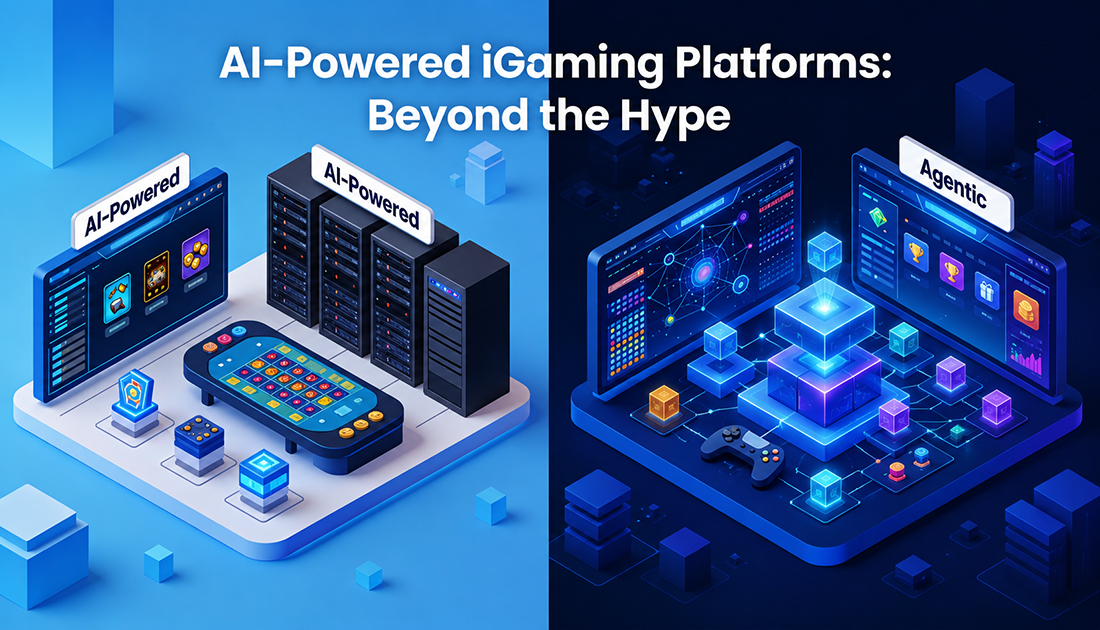
The phrase "AI-powered iGaming platform" has been in heavy circulation for the past two years. Most major platform vendors now describe themselves as AI-powered in their marketing material. The phrase appears in pitch decks, conference panel titles, investor memos, and the homepages of platforms that, until recently, described themselves with no reference to AI at all. The category has become crowded enough that the term has lost most of its descriptive value.
Underneath the marketing layer, there is a category that is genuinely new and a category that is largely a rebrand. The genuinely new category is the agentic iGaming platform. This is a definitional guide to what that term actually means, how it differs from the AI-powered platforms it gets confused with, and what an operator should look for if they are evaluating one.
The simple definition
An agentic iGaming platform is an iGaming platform built around a coordinated ecosystem of AI agents that perform the operational work an operator would otherwise hire teams of humans to do — brand creation, product management, UI design, frontend development, original game development, QA, customer service, SEO, paid acquisition, social media, and other functions — with each agent producing production-ready output that goes live on the operator's real systems, and each agent collaborating with the others through a shared platform layer.
Three elements in that definition matter, and the absence of any of them moves the platform out of the agentic category and into something adjacent.
First, the agents perform work, they do not assist with it. The Brand Orchestrator creates a deployed brand. The Frontend Developer Agent produces shipped UI code. The Customer Services Agent++ resolves real player queries by acting against real systems. This is the distinction between an agent and a tool: a tool helps a human do work; an agent does the work.
Second, the agents produce production-grade output. The output goes live on the operator's actual platform, with the operator's actual players, against the operator's actual compliance posture. This is the distinction between a demo and a deployment, and it is the line where most AI-in-iGaming announcements fall short.
Third, the agents collaborate. The Product Head's PRD becomes the Product Manager's tickets becomes the Designer's component hierarchy becomes the Frontend Developer's code becomes the QA Agent's test cases. Each agent's output is the next agent's input. This is the distinction between a platform that has AI agents and a platform that is genuinely agentic — the latter has the orchestration layer that makes the agents work as a system rather than as a collection of isolated tools.
What an agentic platform is not
Four adjacent categories regularly get described as agentic but are not. Distinguishing between them is the most useful filter an operator can apply when evaluating platforms.
It is not an AI-added iGaming platform. The largest category in the market — and the one the established platform incumbents have been moving into — is a conventional platform with AI features bolted on. A smarter chatbot in customer service. A recommendation engine on the casino lobby. A fraud-detection model in compliance. These are AI features added to a non-AI platform. The architecture underneath is the same architecture it was five years ago. AI-added is a real and useful category, but it is not the same as agentic, and operators who pick an AI-added platform expecting agentic outcomes will be disappointed.
It is not an AI tool stack. There is now a long list of standalone AI products that an operator can buy — an AI copywriter for marketing, an AI design tool for creative, an AI chatbot for CS, an AI analytics tool for player insights. Each of these is useful in isolation. None of them collaborate. None of them sit on a shared platform layer. None of them produce output that is automatically wired into the operator's wallet, KYC, bonus engine, sportsbook, and casino. Buying ten AI tools does not produce an agentic platform — it produces ten AI tools and an integration headache.
It is not a vertical AI agent product. There are specialist AI agent products in iGaming that handle a single function well — customer service agents, KYC agents, marketing agents. A specialist CS agent product is not the same thing as the CS agent on an agentic platform. The specialist product gives the operator one agent. The agentic platform gives the operator one agent that is part of a coordinated roster of agents, sitting on a shared platform with shared data, shared compliance, and shared integration patterns. The vertical agent is a feature; the agentic platform is an architecture.
It is not a no-code platform with AI assistance. The fast-launch category — platforms that promise an operator can be live in days through templated configuration and a low-code editor — sometimes describes itself as AI-powered or agentic. The reality is that these platforms accelerate the configuration of a templated operator, not the creation of a differentiated one. The work an AI assistant does in this context is suggesting copy, picking colours, choosing a template. The work an agentic platform does is producing original branded games, building a bespoke UI, and running a 24/7 multilingual customer service operation. The two are different products solving different problems for different operators.
The test for whether a platform is agentic is not whether it uses AI. It is whether the AI does the work, produces output that goes live, and collaborates with other AI doing other work, on a shared platform that makes the output production-ready.
Why this is a new category and not a marketing term
The fair question to ask is whether "agentic" is a meaningfully new category or just the next term in a sequence — AI-powered, then AI-native, then agentic — that the industry will keep cycling through every eighteen months. There is a defensible answer.
The technical capability that makes agentic platforms possible is genuinely new. Until around 2023, the language models underneath any AI agent were not capable enough to do the work end-to-end. They could draft copy that a human edited. They could suggest a UI layout that a designer interpreted. They could route a customer service ticket that a human resolved. The output was assistive, not autonomous, because the underlying capability was not there. Between 2023 and 2026, the underlying capability changed materially. The same agent that suggested a UI layout in 2023 produces shippable UI code in 2026. The same agent that drafted copy in 2023 runs a paid acquisition campaign in 2026. The same agent that routed CS tickets in 2023 resolves them end to end, in the player’s own language, every hour of the day, in 2026.
This is not a marketing shift. It is a capability shift. The platforms being built around the 2026 generation of agent capability are architecturally different from the platforms that were built around the 2023 generation, in the same way that mobile-first platforms in the early 2010s were architecturally different from the desktop platforms that preceded them. The category name is downstream of the architecture.
The reason most established platform incumbents will not become agentic is that the architecture is not retrofittable. An AI-added platform sits on top of an iGaming platform that was built in the previous generation, with human-team workflows assumed at every layer. An agentic platform sits on top of an iGaming platform that was built with agent workflows as a design principle — shared data layers, agent-to-agent handoffs, audit trails for agent actions, exception escalation patterns, and integration points that are agent-callable rather than human-clickable. Retrofitting an existing platform to this architecture is approximately the same engineering effort as building a new platform. Most incumbents will not make that investment, which is why the agentic category is being defined by newer entrants rather than by incumbent reinvention.
What an agentic platform does for an operator
The practical question for an operator is not whether agentic is a real category — that conversation is for analysts and conference panels. The practical question is what an agentic platform actually changes about running an iGaming operation.
It changes the team-size economics. An operator running on an agentic platform can operate with a fraction of the headcount that an operator running on a conventional platform requires. The 40-person operator becomes the 8-person operator. The functions that required teams — design, frontend development, content marketing, paid social, customer service — are handled by agents, with humans focused on strategy, regulatory work, partnerships, and the complex residual that the agents escalate.
It changes the speed of launch. An operator launching a new brand, a new market, a new vertical, or a new sub-product compresses the timeline from months to weeks. The Brand Orchestrator creates the brand. The Designer and Frontend Developer Agents build the UI. The Casino Originals Agent produces the original games. The SEO and Meta Ads Agents stand up the acquisition channels. Functions that ran in serial — because each team handed off to the next — now run in parallel, because the agents coordinate through the platform.
It changes the cost structure of customer service. The CS Agent++ — the most public proof point of the agentic platform model — resolves inbound queries end to end, in the player’s own language, every hour of the day, at an established operator deployment, with no human in the loop. What still reaches a human is genuine human-judgement work. Coverage extends to 24/7 in every language the player base speaks. Peak-load handling becomes a non-event.
It changes the differentiation profile. Operators running on conventional platforms tend to look similar to each other, because the platform shapes the product. Operators running on agentic platforms have more room to be differentiated, because the agents produce bespoke output — original games, original UI, original brand voice, original content — rather than configured templates. The platform stops being the ceiling on differentiation.
And it changes the moat profile. An operator with a small team running on an agentic platform can compete with a large operator running on a conventional one, on substantially better economics. This is the shift that has not yet been fully priced into the industry, and it is the shift that will define which operators are competing five years from now.
What to look for when evaluating an agentic platform
If an operator is evaluating platforms in 2026 and the agentic category is on the shortlist, there is a set of questions that separates the platforms that are genuinely agentic from the ones using the term as marketing.
How many agents does the platform actually deploy, and what does each one produce? A platform that lists "AI throughout the stack" without naming specific agents and specific outputs is not agentic — it is AI-added. A platform with a named roster of agents, each with a defined scope and a defined output, is the genuine category.
Does the agent output go live, or does a human edit it first? This is the cleanest test. If the Frontend Developer Agent produces code that a human engineer rewrites before shipping, the agent is assistive. If the code ships as-is, the agent is autonomous. Both have value, but only the second is agentic.
Do the agents collaborate, or do they operate independently? Ask the vendor to walk through a workflow that touches multiple agents — for example, building a new branded slot from a marketing brief, end to end. If the workflow has clean handoffs between agents through the platform, the platform is agentic. If the workflow involves a human carrying output from one agent to the next, the platform is a collection of agents but not an agentic platform.
Does the platform have production deployments at scale? An agentic platform with no established-operator deployments is a roadmap, not a product. The capability is too new for there to be many established-operator deployments yet, but "some" is a meaningfully different number from "none." Ask for case studies. Ask for the metrics. Ask whether the customer is named or anonymous, and if anonymous, why.
Is the underlying platform real? This is the load-bearing question that operators sometimes miss. An agentic layer on top of a weak platform produces weak agent output, because the agents inherit whatever the platform underneath them can do. The platform has to be a real, enterprise-grade iGaming platform — with the wallet integrations, the game provider connections, the payment rails, the compliance controls, the audit infrastructure, and the operational maturity that any serious iGaming platform requires. If the agentic platform is built on a thin or new underlying platform, the agents will be impressive in demos and brittle in production.
Where the category is going
The agentic iGaming platform category is at the start of its definition phase. Over the next two years, the category will tighten. The platforms that genuinely deliver the architecture will pull away from the platforms using the term loosely. Operators will develop a sharper instinct for the difference. The trade press will start running comparative reviews. Analysts will publish frameworks. The category will mature.
In the same period, the established platform incumbents will respond — not by becoming agentic, because the retrofit cost is too high, but by adding more AI features and pushing the AI-powered framing harder. There will be a genuine confusion in the market for a couple of years between AI-added platforms calling themselves agentic and the platforms that actually are. The operators who can read the difference will pick the right platform. The operators who cannot will end up on AI-added platforms that look similar in marketing material and behave very differently in operation.
The economic prize on the other side of that sorting process is large. An agentic platform changes the headcount, the speed, the cost structure, and the differentiation profile of an iGaming operator. The operators who get onto the right platform in the next two years will be the operators competing on dramatically better economics by 2028. The operators who get onto the wrong one will be running larger, slower, more expensive operations against competitors who don't have to.
Bluestuff.ai is built as an agentic iGaming platform — the agentic operating system for iGaming, with a workforce of specialised AI agents that builds, runs, and grows the operator's entire sportsbook and casino operation, on enterprise-grade infrastructure that makes the agents' output production-ready rather than prototype-grade. The category is new. The architecture is new. The economics are different. This is the operator's lens for evaluating what that change actually means.