Search for an AI iGaming platform in 2026 and you will find a dozen products that describe themselves the same way and do entirely different things. Some let you launch in a weekend. Some put every bet on a public ledger. Some hand you a managed casino with a stock library of games. Some turn a text prompt into slot art. They are all, in their own way, AI in iGaming — and they are not interchangeable. This is a fair map of the landscape: what each model actually does, where it stops, and where the agentic model fits among them. It is not a teardown. Most of these models are genuinely useful to someone. The point is to be clear about which problem each one solves before you pick one.
The four models of AI in iGaming
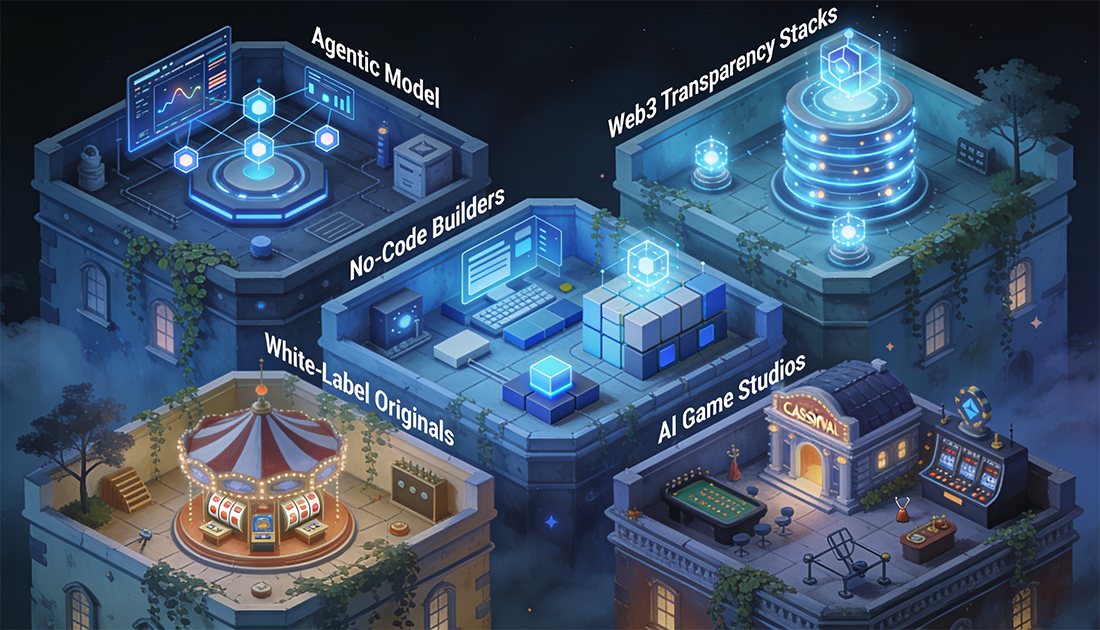
Strip away the marketing and the AI iGaming market in 2026 sorts into four recognisable shapes. Each is built around a different idea of what the AI is for. None of them is wrong. They simply do different jobs, and the confusion in the market comes from describing all four with the same word.
No-code / fast-launch
Web3 / on-chain
White-label & managed originals
Prompt-to-slot studio
No-code / fast-launch builders
The no-code iGaming platform is the most visible model, because it makes the boldest promise: configure a templated operator through a low-code editor and be live in days. Pick a theme, drop in a logo, choose from a library of games and payment providers, and the platform assembles a working sportsbook or casino around your choices. For an operator who needs to be in market quickly and is comfortable looking like the other operators built on the same templates, this is a real and reasonable answer. What it does not do is produce differentiation. The AI in this context suggests copy, picks colours, and recommends a template — it accelerates the configuration of a standard operator rather than the creation of a distinctive one. The speed is genuine. The shallowness is the trade you make for it.
Web3 / on-chain transparency stacks
The Web3 model is built around a single, valuable idea: provable fairness. Bets, outcomes, and settlement are written on-chain, so a player can verify that a game was not rigged and a balance was not quietly adjusted. For crypto-native players who have learned to distrust opaque operators, this transparency is a real selling point, and the programmable-wallet and stablecoin tooling that comes with it is genuinely useful. But transparency is a layer, not an operation. An on-chain settlement stack proves that the games are fair; it does not design the brand, build the UI, create the original games, run customer service, or drive acquisition. It answers the question “can I trust the outcomes?” — which is important, and is not the same as the question “how do I build and run a competitive operator?”
White-label & managed originals
The white-label and managed-service model is the incumbent. An established platform — often with fifteen or twenty years behind it — gives the operator a complete, supported product to run: the platform, the games, the integrations, and frequently the licence, delivered as a managed service. It is the safe, proven choice, and for many operators it works exactly as advertised. The constraint is differentiation again, in a different form. The originals are stock or lightly customised — you can re-skin a library, adjust CSS and colours, swap a logo — but the games themselves are the same games every other operator on the platform is running. You are buying a competent, managed operation built around a shared product. What you cannot buy through it is a genuinely bespoke one.
Prompt-to-slot / AI game studios
The newest and most eye-catching model is the AI casino game studio — prompt-to-slot tools that generate game art, themes, and assets from a text description. Type a brief, get slot symbols, backgrounds, and a visual theme in minutes. As a creative accelerator this is impressive, and it genuinely compresses the art-production timeline that used to require a studio. But generating the art is one layer of building a game. It is not the game engine, not the maths model, not the integration with the wallet, not the QA, not the compliance posture, and not the deployment to live players. A prompt-to-slot tool gives you assets. Turning assets into a shippable, settled, regulated original is the rest of the work — and the rest of the work is most of the work.
What is an agentic iGaming platform?
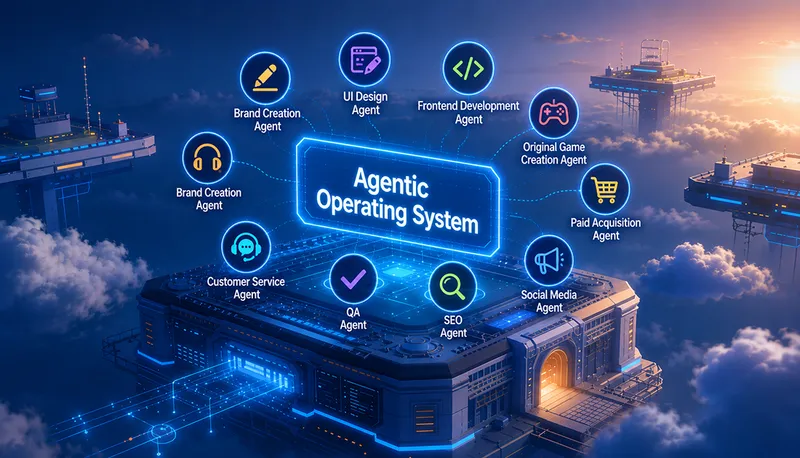
Each of the four models above addresses one layer of running an iGaming operation. The fast-launch builder addresses configuration. The Web3 stack addresses trust. The white-label addresses managed delivery. The game studio addresses art. The agentic iGaming platform is built around a different premise: not a tool for one layer, but an operating system that runs the whole operation through a roster of AI agents that do the work and hand off to each other. We cover the category definition in depth in our companion piece, What is an agentic iGaming platform? — here the relevant point is where it sits relative to the other four models.
Instead of accelerating one function, an agentic platform staffs the entire operation with AI agents for iGaming operators, each owning a job and passing its output to the next. The roster runs end to end:
- Brand Orchestrator — generates and deploys the operator brand from a positioning brief
- Product Head — writes the PRD and gates what gets built
- Product Manager — turns the PRD into structured, sprint-ready tickets
- Designer — extracts design tokens and the component hierarchy
- Frontend Developer — builds production React/TypeScript UI from the design system
- Casino Originals — builds the bespoke originals suite on proven game engines
- QA — generates and runs functional tests against the acceptance criteria
- Reviewer — code-reviews every pull request at senior-engineer level
- API Analyst — wires the platform to game providers, payments, and KYC vendors
- SEO & Content — builds the organic acquisition layer
- Meta Ads — runs paid acquisition and creative variants
- Social Media — runs organic social tuned to the market’s register
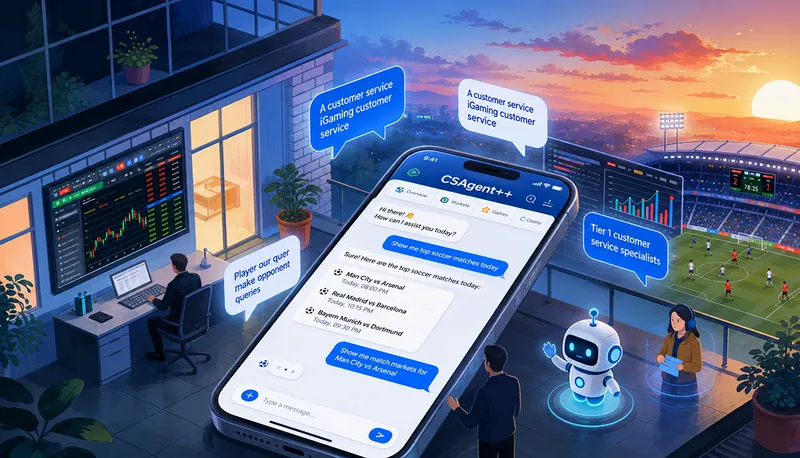
- CS Agent++ — resolves player queries against real systems, 24/7, in every language
The difference is not that one of these agents is cleverer than a prompt-to-slot tool or a no-code editor. The difference is that they collaborate on a shared platform layer, so the Product Head's brief becomes the Designer's tokens becomes the Frontend Developer's code becomes the QA Agent's tests — without a human carrying output from one tool to the next. That collaboration is what turns a collection of AI features into an operation.
Every model above does one layer. An agentic operating system does the whole operation.
Why is the agentic model production-ready?
The fair objection to anything described as agentic is that agent demos are easy and agent deployments are hard. Most AI agents in this industry produce demo-grade output because they have no real platform underneath them — they look impressive in a sandbox and fall apart the moment they touch a wallet, a KYC system, or a regulator. The reason the agentic model is production-ready in 2026 is not that the language models are uniquely clever. It is that the agents inherit an enterprise-grade iGaming platform: real integrations to game providers and payment rails, real player data with real compliance controls, audit logging, role-based access, exception handling, and rollback behaviour. The agent that resolves a withdrawal can do so because the platform beneath it knows how to settle one safely.
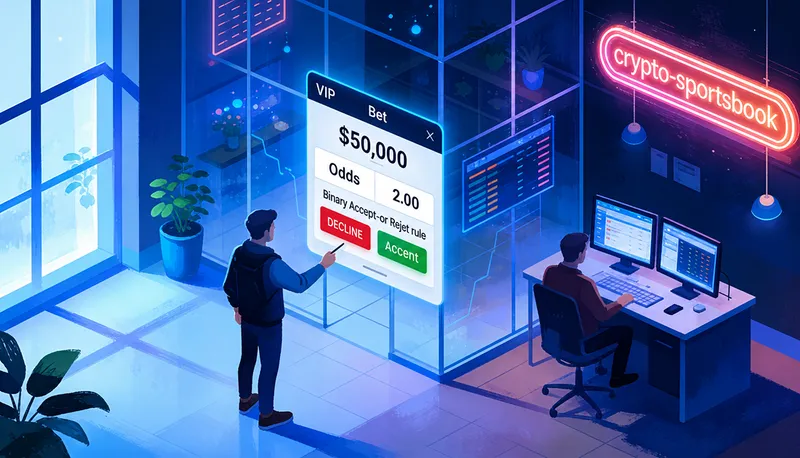
This is also why the four other models cannot simply add agents and become agentic. An agentic architecture has to be built with agent-to-agent handoffs, agent-callable integration points, and audit trails for agent actions as design principles — not retrofitted onto a platform that assumed human teams at every layer. The proof is in what ships. An established operator now resolves its customer service end to end, in the player’s own language, every hour of the day, with the CS Agent++, in production, because the platform does as much work as the model. For a concrete example of the build depth this requires, read the bet no white-label can take — a real-time bet-referral desk that exists precisely because the platform underneath could support it.
So which should you pick?
There is no single best answer — there is the model that fits what you are trying to do. The table below maps the five options against the questions operators actually ask when choosing the best iGaming platform 2026 has on offer. It is meant to be lifted whole.
| Model | Setup speed | AI in the architecture | Originals creation | Runs the operation | Best for |
|---|---|---|---|---|---|
| No-code / fast-launch builder | Days | Assists with config (copy, colours, templates) | Templated, re-skinned library | No — you staff it | Speed-to-market over differentiation |
| Web3 / on-chain transparency | Weeks | Minimal — focus is provable fairness | Usually integrated, not bespoke | No — transparency layer only | Crypto-native players who value provable fairness |
| White-label & managed originals | Weeks to months | Bolted-on AI features | Stock or lightly customised | Managed service, you bring the team | Proven, supported, lower-risk delivery |
| Prompt-to-slot / AI game studio | Minutes for assets | Generative — art and themes only | Art and assets, not full games | No — one creative layer | Accelerating game art production |
| Bluestuff.ai — agentic operating system | Weeks, end to end | Agents do the work across the full stack | Bespoke originals on proven engines | Yes — a roster of collaborating agents | Operators who want a differentiated operation run by a workforce, not a tool |
Read the table fairly and the pattern is clear. The first four models each do one thing well, and if that one thing is all you need, they are the right choice. The agentic model is the only row that answers “yes” to “runs the operation” — because it was built to, not because it added a feature.
Where Bluestuff Mint fits
If the prompt-to-slot studios are interesting to you, the agentic equivalent is worth seeing, because it closes the gap between assets and a shippable game. Bluestuff Mint lets an operator mint bespoke branded originals — not generated art waiting for an engine, QA, and integration, but finished games built by the Casino Originals Agent on proven engines and wired into the wallet, ready for live players. It is the difference between a tool that gives you the picture and a workforce that gives you the game.
Stop buying tools. Hire a workforce.
Bluestuff.ai, the agentic operating system for iGaming, runs the whole operation through a roster of collaborating AI agents on an enterprise-grade platform — not one layer of the stack, but all of it. See what an operation built by agents looks like.