Customer service in iGaming is a problem that scales badly. A standard sportsbook chat widget handles a steady trickle of deposit queries, withdrawal questions, and bonus enquiries during the week. Then a high-profile match kicks off, the betting markets do something unexpected, and ten thousand players hit the chat at the same time — at which point the standard sportsbook chat widget falls over. Agents go into queue. Wait times stretch to twenty, thirty, sixty minutes. Players who came to bet get frustrated, churn, or complain on social media. By Monday morning, the operations team is staring at a backlog and an NPS dip and a hiring brief for the next CS expansion.
Every operator above a certain scale has lived a version of this. The standard response is to throw more humans at it. Hire more agents. Expand the night shift. Add another tier of escalation. Or — increasingly common over the past two or three years — bolt a chatbot on the front of the queue to deflect the easy queries before they reach a human.
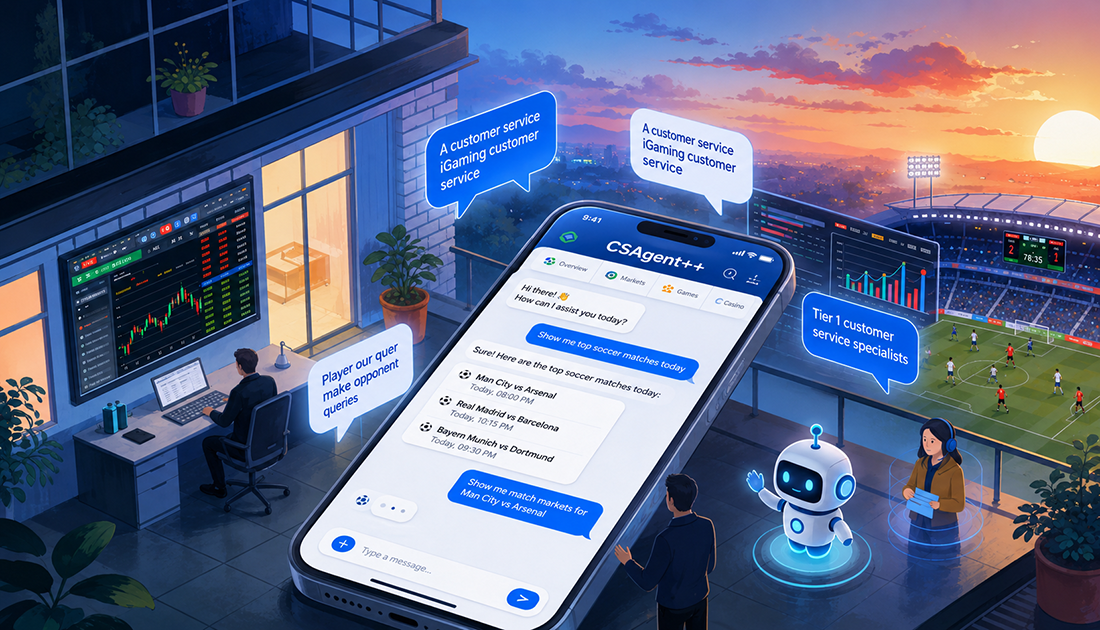
An established African sportsbook operator decided to try something different. They replaced their existing CS chat widget with Bluestuff's Customer Services Agent++ — not as a deflection layer in front of human agents, but as the primary CS surface. The results have rewritten how the operator thinks about customer service, what it costs, and what role it plays in their business.
This is the deployment story.
The starting point
Before the deployment, the operator was running a conventional CS setup: an off-the-shelf chat widget on the website and mobile app, an outsourced first-line team handling routine queries, an in-house second-line team for complex cases, and a tooling stack stitched together from CRM, knowledge base, and ticketing software. The team was competent and the SLAs were within industry norms most of the time — but the cost per resolution was rising, the peak load problem was unsolved, and player satisfaction with CS was a recurring complaint in surveys.
The operator's CS team handled the standard mix: deposits and withdrawals (the largest category by volume), KYC and account verification, bonus enquiries and promotion questions, sports betting questions about specific markets and settlement rules, and the long tail of account issues, password resets, and "my bet should have won" disputes.
They had tried a chatbot deflection layer before. It had handled the very easiest queries — "what are your operating hours" — but anything that required a lookup against the player's actual account data was kicked to a human. In practice it deflected maybe 15% of inbound, and players learned quickly to type "agent" to skip it. That isn't what the operator wanted from the next deployment.
What changed with the CS Agent++
The CS Agent++ deployment was different in one important way: the agent was wired into the operator's actual systems. Wallet API. KYC system. Bonus engine. Sportsbook. Casino. Player profile data. When a player asks "why hasn't my withdrawal arrived," the agent doesn't read a knowledge-base article and apologise. It looks up the withdrawal, checks its status against the payment processor, checks the player's KYC level, identifies the reason for the delay, and either resolves it or explains exactly what the player needs to do next.
This is the line that separates an actual AI agent from a chatbot. A chatbot recognises intent and serves a response. An agent recognises intent, takes an action against a real system, and reports the outcome. The CS Agent++ is the second category.
The deployment went live in stages. First as a parallel channel running alongside the existing chat widget, handling a small percentage of inbound for monitoring. Then promoted to primary with the human team as escalation. Then expanded across deposits and withdrawals, then bonuses, then sportsbook queries, then casino-specific questions. Each expansion was measured: resolution rate, accuracy on edge cases, player satisfaction, escalation rate to humans.
Within roughly four months of the staged rollout, the agent was resolving inbound CS queries end to end, in the player’s own language, every hour of the day. No human in the loop. What still escalated to human agents was the genuinely complex residual: regulatory disputes, fraud investigations, sensitive account issues that required judgement rather than process.
The customer service channel went from being a cost centre the operator wanted to minimise to a surface the operator wanted players to spend more time on.
What end-to-end resolution actually means for the business
Resolution is the headline, but it isn't the most interesting part. The operational changes underneath are what matter.
Human CS headcount per shift dropped. The operator didn't run a redundancy programme — attrition handled most of it, and the team was rebalanced toward complex case handling, fraud investigation, and VIP management. The work that humans were left doing was higher-value and more interesting, which had an unexpected effect on retention in the CS team itself: turnover went down, not up.
Peak load handling stopped being an issue. The CS Agent++ handles ten thousand simultaneous conversations the same way it handles ten — there is no queue, there is no wait time. The match-day scenario that used to break the standard chat widget became routine. The operator stopped staffing peak shifts around event calendars.
Coverage went to 24/7 in every language the operator's player base actually speaks. The previous setup had English coverage around the clock, but Portuguese-speaking and French-speaking players in some of the operator's markets had reduced overnight coverage because the human team didn't have the headcount to cover all languages on all shifts. The agent handles all languages at the same level of fluency, continuously.
Cost per resolution dropped meaningfully. The operator hasn't published the exact number, and it varies by query category, but the order-of-magnitude shift was significant enough that the platform investment paid back within the first year of operation.
Where the deployment got more interesting
End-to-end resolution is the version of the story that fits in a press release. The version that the operator's team actually finds more interesting is what happened after.
Once the CS Agent++ was handling the majority of inbound, the team started asking a different question: if players are spending time in this channel anyway — and they are, because it works — what else can the channel do?
The first expansion was bet placement. A player asks the CS Agent++ for the odds on tonight's match. The agent doesn't just answer the question; it pulls live odds from the sportsbook, presents the markets, and offers to place the bet directly in the chat. The transaction goes through the wallet, the bet is logged, the bet slip appears. Customer service became a betting surface.
The second expansion was game analytics. Players started asking about their own history — "how much did I bet on football this month," "what's my biggest win," "what games have I been playing most." The agent has access to the player's data and can answer these questions in natural language with the player's actual numbers. Players who would never open a dashboard discovered they had a dashboard, accessed through the chat they were already in.
The third expansion was personalised recommendations. The agent knows which slots a player has played, which sports they bet on, which leagues they follow. Recommendations stopped being generic and started being grounded in the player's actual behaviour. The recommendation conversion rate, predictably, went up.
The fourth — and this is the one the operator's team finds most striking — was branded mini-game versions of the operator's originals inside the chat. A player resolves a deposit query, and on the way out, the agent offers a 90-second branded mini-game. The games are built by the Casino Originals Agent, branded to the operator, connected to the wallet for stake and reward. The customer service channel turned into an engagement surface. Players started opening the chat for reasons other than having a problem to solve.
This is where the language about a "companion app" started getting used internally. The CS Agent++ stopped looking like customer service software and started looking like a primary interface for a meaningful chunk of the operator's player base — a 24/7 personalised assistant who happens to also handle support.
Why this was harder than it sounds
It is worth being explicit about why this kind of deployment hasn't already been done widely across the industry, given how much money is being spent on AI in iGaming.
Building a chatbot that recognises intent and answers FAQs is straightforward. Off-the-shelf tools have done it for years. The hard part — the part that gates the leap from chatbot to actual agent — is connecting the system to the operator's wallet, KYC, bonus engine, sportsbook, and casino, with the right authentication, the right audit trails, the right compliance posture, and the right rollback behaviour when something goes wrong. "What if the agent processes a withdrawal incorrectly" is not a hypothetical question in this industry. It is a regulator question, a fraud question, a customer trust question, and a financial reconciliation question, all at once.
The CS Agent++ works in production because Bluestuff is a platform, not just an agent. The agent inherits the platform's compliance controls, audit logging, role-based access, exception handling, and integration patterns. The same enterprise-grade infrastructure that supports the operator's sportsbook and casino supports the agent. That is the load-bearing reason the deployment works.
Anyone can build an AI agent. Most AI agents in this industry produce demo-grade output because they have no real platform underneath them. The CS Agent++ produces production-grade output because the platform is doing as much work as the model.
Two paths into the agent for other operators
From the conversations the operator's team has had with peers since the deployment went public, two distinct paths into the CS Agent++ have emerged for other operators thinking about it.
The first is the new-operator path. An operator launching for the first time — particularly in growth markets where the cost of staffing a multilingual 24/7 CS team is prohibitive — deploys the CS Agent++ as the primary CS channel from day one. There is no legacy widget to replace, no existing team to retrain, no migration. The agent is the customer service operation, and the operator builds the human escalation team around the residual.
The second is the established-operator path — which is the path the established operator in this case study took. There is an existing setup, an existing team, an existing widget, an existing tooling stack. The CS Agent++ deploys alongside, runs in parallel for monitoring, gets promoted to primary, and the team rebalances toward complex case handling. This path is slower, but it carries less risk and produces a clearer business case, because the operator can measure the agent against the team it is augmenting.
In both paths, the expansion into bet placement, game analytics, recommendations, and mini games comes later — once the CS layer itself is stable. The companion-app evolution is what happens when an operator stops thinking about the agent as a CS tool and starts thinking about it as a player interface.
What the operator says about it now
Eighteen months in, the way the operator talks about CS internally has changed. It is no longer described as a cost line to be minimised. It is described as a product surface — one of the highest-engagement channels in the operation, and one of the most important touchpoints for player retention. The conversation in operational reviews shifted from "how do we reduce CS spend" to "how do we expand what the agent does."
The remaining human CS team is doing more interesting work. The peak load problem is solved. Coverage is 24/7 in every language the player base speaks. Players are spending more time in the channel and converting more often inside it. The agent keeps getting better as it sees more queries and the platform keeps adding capabilities the agent can call.
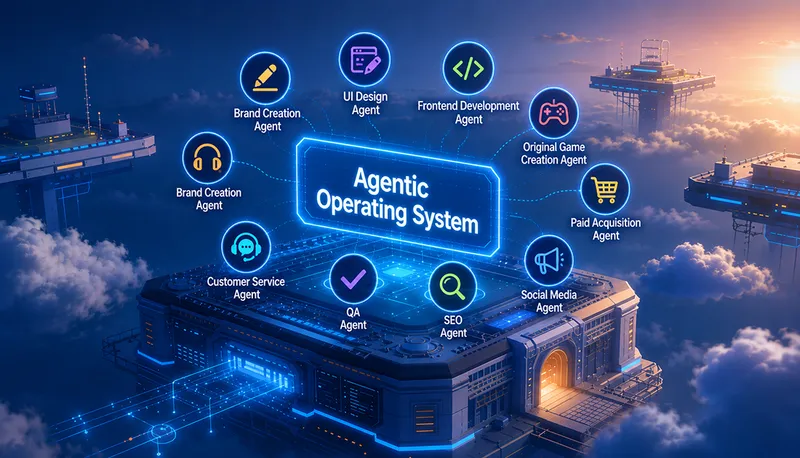
This is what an agentic customer service deployment looks like when it works. It is also what makes the broader case for agentic platforms in iGaming credible — because if a single agent can do this for a single function, the same pattern applies across the rest of the operator stack. The CS Agent++ is one agent in a much wider Bluestuff roster. The others are catching up.