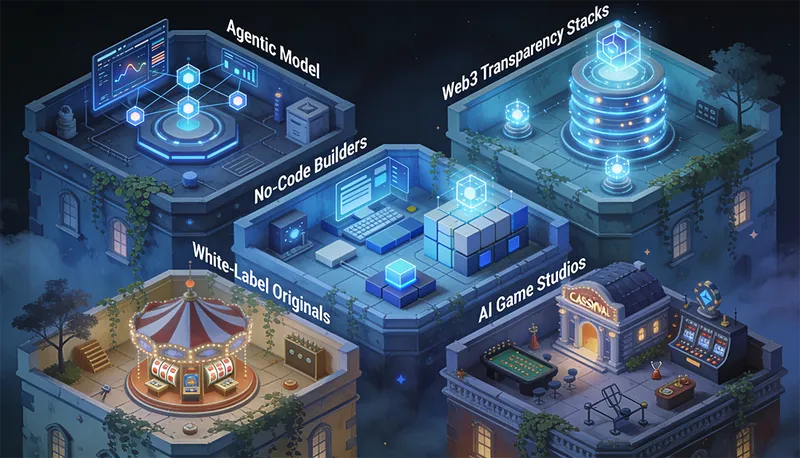
Most iGaming platforms that claim to be AI-powered have one or two AI features bolted onto a conventional white-label. A chatbot in customer service. A recommendation engine on the casino lobby. Maybe a fraud-detection model running quietly in compliance. That isn't an AI platform. It's a regular platform with AI features.
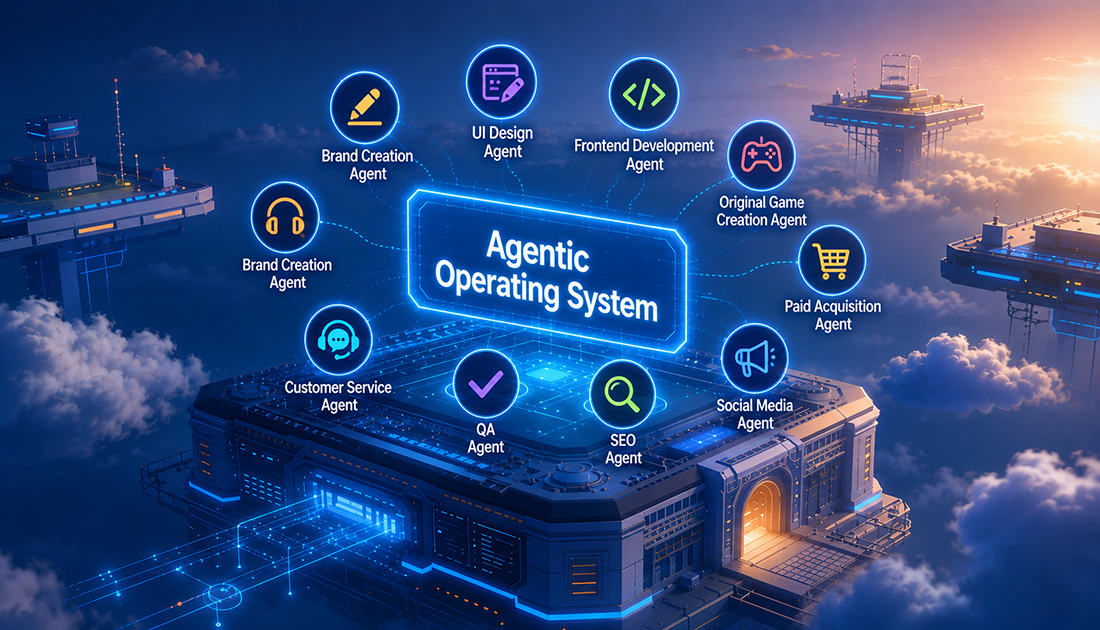
Bluestuff.ai is built differently. It is the agentic operating system for iGaming — a coordinated workforce of specialised AI agents that handle the work an operator would otherwise hire entire teams to do. Brand creation. UI design. Frontend development. Original game creation. QA. Customer service. SEO. Paid acquisition. Social media. The agents do the work, and they work together on top of an enterprise-grade iGaming platform, which is why their output goes live rather than ending up as a demo.
This is a reference to the agent roster — what each agent is, what it produces, and where it sits in the operator workflow.
How the agents fit together
The roster splits into two halves.
B2B agents sit on the operator side of the platform. They build and run the operation itself — from creating the brand and designing the casino UI through to writing the marketing copy and managing the ad spend. They span product, design, development, QA, and growth.
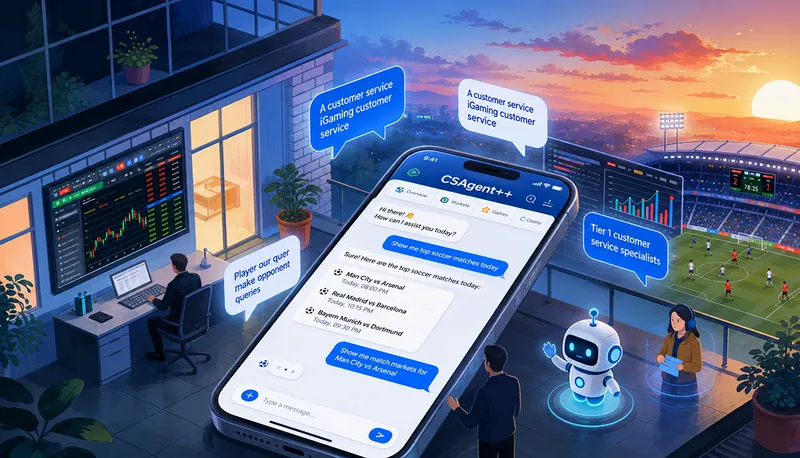
B2C agents sit on the player side. They transform the experience players have when they interact with the operator — primarily through the Customer Services Agent++. One agent, but with disproportionate impact: an established operator now resolves its customer queries end to end, in the player’s own language, every hour of the day, with the CS Agent++ alone, and the same agent has evolved into a full companion-app experience with bet placement, game analytics, and branded mini-game versions of the operator's originals inside the chat — powered by the Casino Originals Agent.
What makes the system genuinely agentic — rather than "a platform that includes AI" — is that the agents collaborate. The Product Head writes a PRD. The Product Manager turns it into structured JIRA tickets. The Designer extracts design tokens and component hierarchy. The Frontend Developer builds the UI. The QA Agent tests it. The Reviewer Agent code-reviews it. The API Analyst wires it to the platform. Each agent's output becomes the next agent's input, and the platform underneath keeps the whole chain production-ready.
B2B agents — building and running the operation
Brand Orchestrator
Full-stack brand creation and deployment. Given a market positioning brief, target audience, and regulatory context, the Brand Orchestrator generates a complete operator brand — name candidates, logo direction, colour system, typography, brand voice — and then deploys and configures it across the platform. New/small operators use it to launch without hiring a brand agency. Established operators use it to spin up sub-brands and white-labels at speed.
Product Head
An iGaming Product Head, in agent form. Generates Product Requirements Documents from a strategic brief, runs competitor analysis on the feature set, evaluates mock-ups against operator goals, and gates the product pipeline before tickets move to engineering. This is the agent that asks "why are we building this?" before anyone writes a line of code.
Product Manager Agent
Takes the Product Head's PRDs and produces structured JIRA-ready tickets — summary, description, acceptance criteria, story points, dependencies. Where a human PM would spend two days turning a brief into a sprint-ready backlog, the Product Manager Agent does it in minutes, with consistent formatting and acceptance criteria that the QA Agent can actually run tests against.
Designer Agent
UI/UX design specialist. Extracts design tokens — colours, typography scales, spacing systems, component states — from existing brand assets, Figma files, or even competitor reference screenshots. Builds out the component hierarchy and design system that the Frontend Developer Agent then implements. The handoff is structured, not interpretive — the Frontend Developer gets specifications, not vibes.
Frontend Developer Agent
Senior frontend architect for React and TypeScript. Builds production-grade casino and sportsbook UIs against the design system the Designer Agent produced. Handles state management, responsive layouts, performance budgets, and accessibility. Output is real code that ships to real players — not a prototype, not a Figma export, not a vibe-coded shell.
Casino Originals Agent
The differentiator. Most white-label platforms let operators customise CSS and colours on a small library of stock originals. The Casino Originals Agent builds your entire originals suite from any design input — a Figma file, a set of concept screenshots, a written brief, even a sketch — and connects them to proven game engines (Crash, Slots, Card Games, Plinko, Mines, Number Games). The live Pepe/Mog Crash original built end-to-end for a Web3 operator is the proof point. This is the capability that made Stake Originals a competitive advantage for operators who could afford an in-house studio. The Casino Originals Agent delivers it without the team.
QA Agent
Functional test creation and execution, including manual test replication via Playwright. Reads acceptance criteria from the Product Manager Agent's tickets and generates test cases that cover the happy path, the edge cases, and the regulatory edge cases (because in iGaming, "the bet should be settled correctly" isn't an edge case — it's the whole product). Catches regressions before they reach production.
Reviewer Agent
Code review at the senior-engineer level. Reads pull requests from the Frontend Developer and Casino Originals Agents, flags architectural issues, security concerns, performance problems, and style inconsistencies. Acts as the gate between development and merge — the same role a tech lead plays on a mature engineering team, but available continuously and at scale.
API Analyst
Specialises in iGaming API integrations — game providers, payment processors, KYC vendors, affiliate trackers. When an operator wants to onboard a new game studio or payment partner, the API Analyst reads the partner's documentation, maps the endpoints to Bluestuff's internal schemas, identifies authentication and webhook requirements, and produces the integration spec. Integration work that takes weeks of back-and-forth between engineering teams gets compressed into a structured handoff.
SEO & Content Agent
Organic acquisition. Researches keyword clusters relevant to the operator's market, identifies content gaps against competing operators, writes long-form SEO content, and produces metadata, schema markup, and internal linking structures. For operators in growth markets where paid acquisition costs are climbing fast, organic is the moat — and this is the agent that builds it.
Meta Ads Agent
Paid acquisition on Meta platforms. Generates creative variants, writes ad copy tuned to the operator's brand voice, builds audience targeting segments, sets up campaign structures, and monitors performance for re-allocation. Most operators staff a small paid social team plus a creative agency to do this work. The Meta Ads Agent replaces the operational layer and leaves the strategic decisions with the operator.
Social Media Agent
Organic social — content calendar, post drafting, engagement, community management. Tuned to the operator's brand voice and the cultural register of their target market (which matters more than most platforms acknowledge: the tone that works in Lagos is not the tone that works in São Paulo). Operators get a continuous social presence without staffing a social team.
B2C agents — transforming the player experience
Customer Services Agent++
The agent with the most public proof. An established African operator replaced its standard CS chat widget with the CS Agent++ and now resolves player queries end to end, in the player’s own language, every hour of the day — deposits and withdrawals, transaction queries, bonus enquiries, sports betting questions, account issues. Human CS headcount per shift dropped. Peak load handling — the moment when 10,000 players hit the chat at once because there's an issue with a popular match — became a non-event. The agent doesn't route tickets to humans; it handles them. Humans now handle the residual that genuinely needs human judgement.
But the case study evolved beyond customer service. The CS Agent++ became a player companion: in-chat bet placement, game analytics on demand, personalised recommendations based on the player's history, and natural-language interaction in the player's own language, 24/7. The customer service channel turned into a primary engagement surface — a different category of product from the chat widget it replaced.
A CS Agent++ capability worth calling out separately: the Casino Originals Agent builds branded mini-game versions of the operator's originals — Crash, Mines, Plinko, Slots, Card Games, Number Games — and these are surfaced inside the CS Agent++ chat. A player asks about a deposit, gets it resolved, and is offered a 90-second branded mini-game on the way out. The customer service channel becomes an engagement surface. This is what "agents collaborate" looks like in production: the CS Agent++ handles the conversation, the Casino Originals Agent supplies the game, the platform handles the wallet.
What "production-ready" means in practice
The reason this works as a platform — and not as a pile of disconnected AI experiments — is that the agents sit on enterprise-grade iGaming infrastructure underneath. Real APIs to real game providers. Real player data with real compliance controls. Real wallet systems, real payment integrations, real bonus engines, real reporting.
Most AI agent demos look impressive in a sandbox and fall apart the moment they touch a production system. The reason the CS Agent++ resolves queries end to end, in the player’s own language, every hour of the day, at an established operator isn't that the language model is particularly clever — there are clever language models everywhere. It is that the agent is wired into the operator's wallet API, KYC system, bonus engine, sportsbook, and casino, with the right authentication, the right audit trails, and the right compliance controls. Production-grade output is a platform problem, not a model problem.
This is the reason Bluestuff exists as an integrated platform rather than as a collection of agent products. An operator can buy a chatbot from anywhere. What they can't buy elsewhere is a chatbot that places bets, resolves disputes, settles withdrawals, and offers a branded mini-game, all in compliance with the operator's local regulator and tied into the operator's actual systems.
Who uses which agents
New and small operators tend to deploy the full stack from day one. Without a brand team, a design team, a development team, a QA team, a CS team, and a marketing team, the agents are the path to launch. The Brand Orchestrator creates the brand, the Designer and Frontend Developer Agents build the UI, the Casino Originals Agent produces the originals, QA and Reviewer ensure production quality, SEO and Meta Ads drive acquisition, and the CS Agent++ handles players. A two-person operator launches what previously required forty.
Established operators take a different path. They already have teams, they already have infrastructure, and they aren't going to rip-and-replace either. They start by augmenting a specific function — and customer service is consistently the first one, because the case for the CS Agent++ is the strongest and the deployment is the cleanest. Once the CS Agent++ is live and the resolution rate is on the dashboard, the conversation moves to the next function. The Casino Originals Agent is often the second one — operators want branded originals without expanding their dev team. From there it expands across the operation as confidence builds.
The roster keeps growing
We have stopped counting the roster publicly, and that is deliberate — the workforce grows as new functions need agents. What matters is coverage: brand, product, development, QA, originals, growth, and player support are all handled today. New agents are added as patterns emerge in operator deployments — wherever a function is repetitive enough to be agent-able and consequential enough to justify the engineering, it goes on the roadmap. The architecture is built for it: agents are modular, they share a common platform layer, and adding a new one extends the system rather than rewiring it.
What stays constant is the design principle. Every agent on the roster has to do the work, not just assist with the work. It has to produce output that goes live, not output that gets reviewed and rewritten by a human. And it has to collaborate with the rest of the roster, because a single agent in isolation is just another AI tool — and the iGaming industry has plenty of those already.
Bluestuff.ai is the agentic operating system for iGaming. The agent workforce is how that gets delivered.