There is a familiar pattern in African iGaming. An operator decides to launch in Kenya, or Nigeria, or South Africa, or Mozambique. They evaluate platform providers. The shortlist is dominated by European white-label vendors who have been in the market for fifteen or twenty years, built originally for Malta-licensed casinos serving regulated European players on desktop, retrofitted over time for sportsbook and mobile. The operator picks one, signs a contract, and starts the integration.
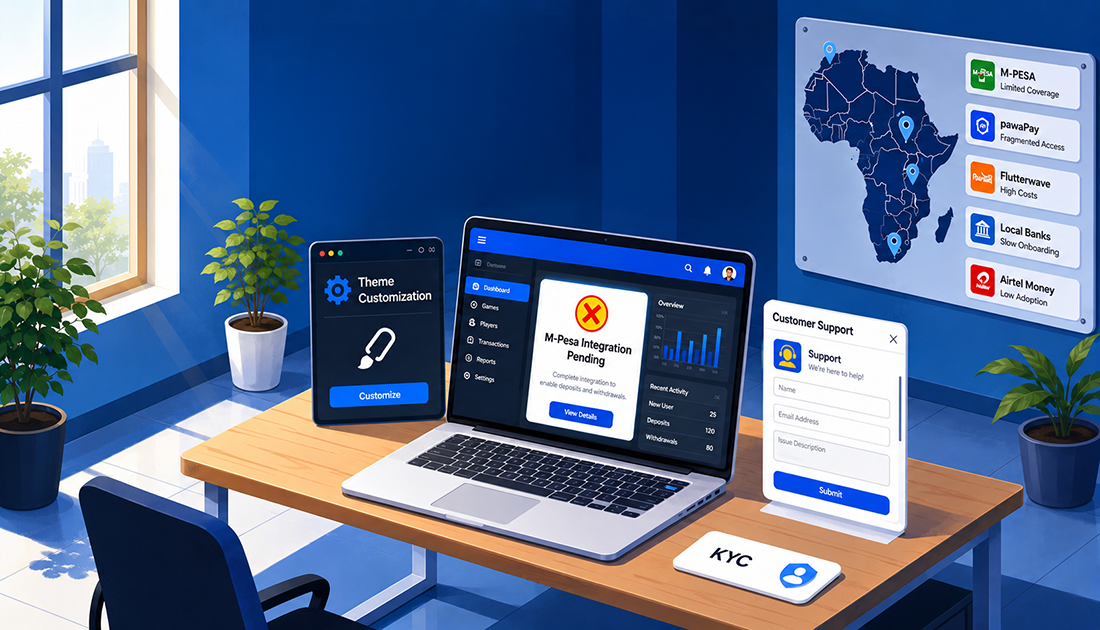
Six months later, they are still trying to make M-Pesa work properly. The brand customisation options are limited to whatever the platform's pre-built theming engine allows. The KYC flow assumes a continental European document set. The customer service tools are English-only by default. Peak-load handling on a Champions League night requires expensive infrastructure scaling. The roadmap from the vendor is dominated by features the operator's mature European clients have requested. And the operator is paying enterprise pricing for a platform that was never designed for the market they are in.
This is not a hypothetical. It is what most African iGaming operators are currently dealing with, to varying degrees. The platforms most operators are building on are European platforms with African deployments — not African platforms. The difference matters more than most people in the industry are willing to acknowledge.
What's actually different about African iGaming
Africa is not a single market and it is not one shape. The regulatory framework in Nigeria is not the framework in South Africa is not the framework in Kenya is not the framework in Mozambique. Some markets are fully regulated, some are in transition, some operate in regulatory ambiguity, and the framework in any one country can change with a new finance act. Any platform serving the continent has to handle multi-jurisdictional compliance as a design principle, not as a feature added later.
Mobile is not a channel. It is the channel. In most African markets, the overwhelming majority of iGaming activity happens on mobile, often on devices and network conditions that European platforms were not designed for. "Mobile-first" in a European context usually means a responsive web layout that works on an iPhone. "Mobile-first" in a Lagos or Nairobi context means low-end Android, intermittent 3G, data costs that matter, and a player who is multitasking between WhatsApp, the operator app, and three other things. Platforms that load heavy JavaScript bundles do not survive this environment. Platforms that assume 4G baseline do not survive this environment. The performance budget is dramatically tighter, and most European platforms have not redesigned for it.
Payments are local. M-Pesa in Kenya. Airtel Money across multiple markets. MTN MoMo. Flutterwave and Paystack in Nigeria. Specific bank rails in South Africa, EcoCash in Zimbabwe, mKesh and eMola in Mozambique. The list is long and it keeps moving. Platforms that came from a European stack treat these as integrations to add later. Operators that came up in African iGaming treat these as core. The lag matters: if a platform takes nine months to add a new mobile money provider, the operator loses ground to competitors who can move in six weeks.
Languages and cultural register vary at the city level, never mind the country level. The tone that works for a sportsbook in Cape Town is not the tone that works in Johannesburg, and neither is the tone that works in Lagos or Accra. A platform whose copy was originally written in English and translated into French and Portuguese will sound off — sometimes badly off — to players in markets where the local register matters a lot. The platforms whose marketing and CS tools were built for European players in three or four core languages do not handle this gracefully.
And then there is the operational reality that every African operator deals with: the team they can hire. Talent is excellent but the pool is smaller than in mature markets, and competition for senior engineers, designers, product people, and CS leads is intense. The European platform model assumes the operator brings a full team to run on top of the platform. In Africa, that assumption breaks. The operator needs the platform to do more of the operational work itself.
Why this is the moment AI-native infrastructure matters
Two things are happening at the same time. Africa is the fastest-growing iGaming market in the world by basically any measure — GGR growth, player numbers, mobile penetration, regulatory clarity in key markets. And AI-native platforms have just become possible in a way that they were not three years ago. The intersection of those two trends is where the next generation of African operators will be built.
An AI-native iGaming platform is not a feature upgrade on a European white-label. It is a different shape of platform, designed for a different shape of market.
The point of AI agents in this context is not novelty. It is leverage. An African operator launching today needs to do what a European operator with a 60-person team does, with a tenth of the headcount. The brand still needs to exist. The UI still needs to be designed and built. Original games still differentiate. SEO still drives organic acquisition. Paid ads still need creative variants. Customer service still has to handle ten thousand players hitting the chat when the Champions League goes wide on a Tuesday night. The work doesn't get smaller. The team that has to do it does.
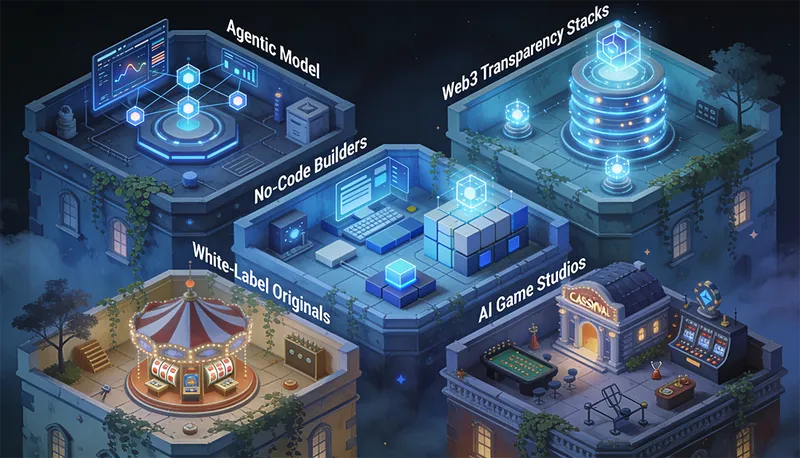
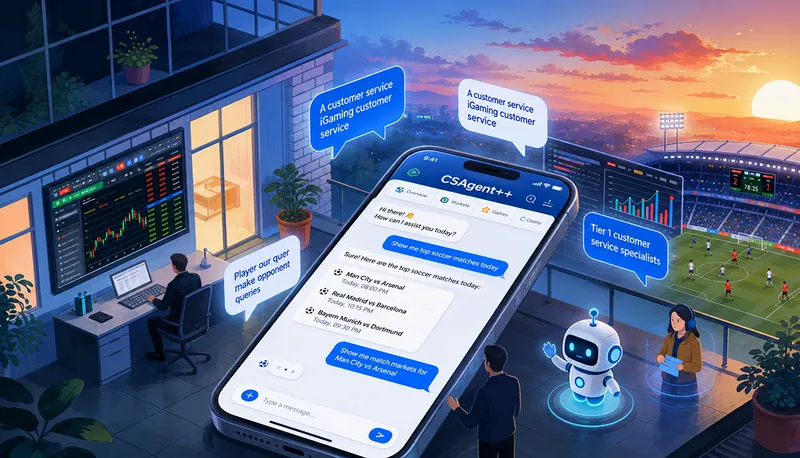
This is the gap that European white-labels do not close. They give the operator a platform to run on, but the operator still has to staff every function on top of it. An AI-native platform does the functions. The Brand Orchestrator creates the brand. The Designer and Frontend Developer Agents build the UI. The Casino Originals Agent creates original branded games without an in-house game studio. The SEO and Content Agent drives organic. The Meta Ads Agent runs paid social. The Customer Services Agent++ handles players in their own language, 24/7, including the peak-load match nights that used to break the standard chat widget.
This is what "purpose-built for Africa" actually means. Not a European platform with a flag in the marketing material. A platform whose architecture is designed for the operational reality African operators are working in.
What an AI-native platform changes about going live
Consider the end-to-end of launching a new operator in a new African market. Under the European white-label model: licence and regulatory work, then platform integration (six to twelve months), then brand creation with an external agency, then UI customisation within the platform's limits, then payment integrations one by one, then KYC localisation, then a CS team build, then the marketing team, then the design team for ongoing creative, then game integrations, then launch. The total elapsed time from green-light to first bet is often eighteen months. The total headcount required is somewhere north of forty.
Under an AI-native platform model, the picture is different. The licence and regulatory work doesn't change — that has to happen either way. But the brand creation happens via the Brand Orchestrator, in days rather than months. The UI is built by the Designer and Frontend Developer Agents against the operator's requirements, not constrained by a pre-defined theme. The original games are produced by the Casino Originals Agent — bespoke branded games, not reskinned templates. Payment integrations are accelerated by the API Analyst Agent reading provider documentation and producing the integration spec. KYC localisation is handled at the platform level. The CS team is the CS Agent++, supplemented by a small human team for the residual. Marketing creative is produced by the Meta Ads, SEO, and Social Media Agents.
The same operator launches in four to six months with a team of six to ten people. The platform does the work that would otherwise require the forty.
This is not a hypothetical. This is the deployment pattern that has been validated at established-operator scale, including the CS Agent++ case study where an established African operator now resolves customer service queries end to end, in the player’s own language, every hour of the day, with no human in the loop. The pattern that worked for CS works for the other functions too — and that is the architecture an African operator should be evaluating, not a European platform with an African deployment team.
What to ask a platform vendor
If you are an operator evaluating platforms for the African market, the questions to ask have changed. The old questions were about feature parity with European competitors: do you have these markets, these games, these payment providers, this reporting. Those questions still matter, but they no longer separate the platforms that will work from the ones that will not.
The new questions are about agent capability and platform architecture. What does your platform actually do for the operator beyond hosting the technology? When the operator needs to launch a new branded original game, does your platform create the game or does the operator need a studio? When the operator's customer service team can't cover a 24/7 schedule in three languages, does your platform handle the conversations or does it route them to a queue? When a new mobile money provider appears in a market the operator wants to enter, how fast can your platform integrate it, and how much of that work has to be done by the operator's engineering team?
If the answers are "we host the platform, you bring the team," the operator is buying a European white-label with a different flag in the marketing. If the answers are "the platform's AI agents do the work," the operator is buying something different — and the economics of running a competitive African operator with a small team start to make sense.
The market is moving faster than the incumbents are
The European platform incumbents are not going to architecturally re-platform around AI agents. The investment required to do that is the same as building a new platform, and the existing customer base ties them to the architecture they have. They will add AI features — a smarter chatbot here, a recommendation engine there — and call it AI-powered. That is not the same thing.
The African market doesn't have to wait. AI-native platforms exist now, designed from the ground up for the operational reality of growth markets, with agent ecosystems that do the work that previously required teams. The operators who recognise this in 2026 will be the operators competing in 2028. The operators who keep buying European white-labels because that is what the industry has always bought will spend the next two years discovering that the gap between an AI-native platform and an AI-added one is not a feature gap. It is a category gap.
Bluestuff.ai was built for this. Purpose-built for Africa, crypto, and Brazil — not retrofitted from European legacy systems and not designed for micro-operators and influencers. An agentic operating system with a workforce of specialised AI agents that builds, runs, and grows the operator's entire sportsbook and casino operation, on enterprise-grade infrastructure that makes the agents' output production-ready rather than prototype-grade.
The continent doesn't need another European white-label with an African deployment team. It needs a platform that was designed for the market it is being deployed into. That is what changes when iGaming infrastructure becomes AI-native.